Monday, October 29, 2012
St. Augustine Questions (Part I)
1. What do you think Augustine means by his desire being “not to be more sure of [God] but to be more steadfast in [Him]?
2. What is the single thing that Augustine identifies as preventing him from giving himself over wholly to the Christian faith?
3. He points out that neither Christ nor St. Paul forbid marriage, so why does he not pursue that path and choose to live his life as a married Christian man.
4. Augustine says that God and His word are “everywhere implied” in the writings of the Platonists. Do a little digging on the Platonists and identify some Christian values that are implied in Platonic thought.
5. Victorinus asked “Then is it walls that make Christians?” His same argument is made today by those who assert that they are Christian but do not “go to Church”. Is the argument any more valid coming from Victorinus than it is today?
6. St. Augustine observes that human nature is to love “regained” things more than those that we have had all along. Do you agree that this is in fact part of human nature? Provide an example from scripture that reflects this as part of God’s nature as well?
7. Again, Augustine observes that “the greater joy is heralded by greater pain.” Does this mean that it is impossible for us to know great joy without great pain? Explain – provide an example from your life and a theologically based example. How does Augustine’s life reflect this maxim? 8. Compare Augustine’s metaphor of the Chain with that of St. Gregory of Nyssa. How could you combine these metaphors.
9. St. Augustine writes at length about how he postpones his conversion and keeps saying later, and later still. He then says the “law of sin is the fierce force of habit”. Does this mean that by repeating a sin we forfeit our will and give the sin control? Explain.
10. Why do you think the influence of the story of St. Anthony is not as strong today as it was on Augustine and Alypius?

Monday, October 15, 2012
St. John Chrysostom
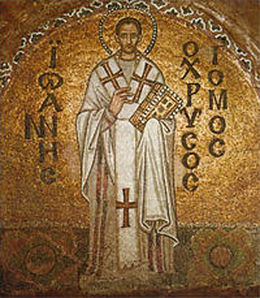
1. Christ says that we do not come to God unless we are “drawn” to him. Explain how Chrysostom says that this does not interfere with our Free Will. Would this imply that God only chooses to draw “some” people to Himself and not all?
2. In discussing the Bread of Life Discourse, what reason does Chrysostom give for Christ “shrouding his explanation in mystery”? What is his criticism of Christ’s audience upon hearing this “hard saying”?
3. At the bottom of pg. 104 Chrysostom describes the role of a disciple in regard to asking questions. What do you think of his description? Do you agree or disagree, and why?
4. Explain why Chrysostom thinks asking the question “How can this man give us his flesh to eat?” is the wrong question to ask. What should have been asked instead – and what do you think the results would have been of asking the “right” question?
5. Chrysostom writes a particularly beautiful passage on page 105: “Therefore, in order that…as the body is joined with his head.” What is the purpose, in his opinion, of this “commingling” with Christ and humanity? What role does the Eucharist play in this “commingling”?
 6. What type of action would be expected of us if we were like “Lions breathing out fire”?
7. Chrysostom references the Eucharist as a “fountain”. How is the Eucharist like a fountain in the life of a Christian?
8. On pg. 107 Chrysostom talks about the danger of taking the Eucharist “unworthily” or with the wrong disposition. What do you think makes for an appropriate (or inappropriate) disposition?
Wednesday, October 3, 2012
St. Gregory of Nyssa

Please read Pope Benedict's catechetical essay on St. Gregory, as well as the writing in your text.
Questions:
1. Very early on, Gregory compares being a Christian to being a doctor, a politician, mathematician, etc. and says that just as these professions require an education, so to does being a Christian. Do you think that we really must have some level of education before we can call ourselves Christian? Explain.
2. What do you make of the "dancing monkey" illustration? We live in a society that largely calls itself "Christian" and yet we persist in crime, violence, injustice, and vice. Are we any more than dancing monkeys?
3. Gregory writes that to unite ourselves to Christ means to share in the "lofty ideals" that are used to describe him. Does this mean that if we do not assume the noble virtues in our character that we are not truly united to Christ? Compare the meaning of this segment to the discussion we had about the Ascension a few weeks ago. (Why did Jesus have to ascend?)
4. How does Gregory assert that Christianity "returns" man to his former or original state?
5. What reason does Gregory give (on the top half of pg. 64) for us being accurate imitators of the Divine?
Tuesday, September 25, 2012
St. Cyril of Jerusalem - Catechesis Questions

1. In the first section the venerable bishop states that "True Religion consists of two elements: pious doctrines and virtuous actions." Contrast this with the idea held by some Christians that salvation by "faith alone". (the notion that faith alone saves us and that our actions / deeds have no bearing on our salvation.)
2. Consider that this document was a series of instructions delivered to people on the verge of converting to Christianity and being baptized. Imagine that you are an adult who knows nothing of the Christian Faith. How would you respond to Cyril's catechetical instruction?
3. Compare the passage "On Christ" to the section of the Nicene Creed, "I believe in Jesus Christ...and his Kingdom will have no end." What are the differences / similarities. Why do you think these assertions about Christ were necessary?
4. People often ask, "If belief in Christ is necessary for salvation, then what happened to all of the people who lived before the coming of Jesus?" How does Cyril adress this question in the passage "On His Burial."?
5. In the passage "On His Ascension" Cyril exhorts his audience to make the sign of the cross often. Even two or three generations ago the sign of the cross was used much more frequently than it is today. Do you think the current and more recent generations are, in Cyril's words, "ashamed of the Cross of Christ"?
6. Pope John Paul II is credited with developing a "Theology of the Body" which we will examine next semester. What can you extract from this brief writing about Cyril's own Theology of the Body, particularly as it pertains to goodness, sexuality, and food?
7. Provide a critique of the current state of fashion and clothing in light of St. Cyril's statements "On Apparel."
Thursday, September 13, 2012
St. Cyprian Questions
1. Do a bit of independent research and try to hypothesize what external factors may have been influencing St. Cyprian in drafting this document?
 2. Analyze St. Cyprian's use of Scripture to support his arguments. Does he use scripture effectively and with sound interpretation? Provide and analyze three examples of his use of Scripture. (Recall that scripture passages are italicized in the text.)
3. St. Cyprian takes a rather harsh stance against those who "break away" from the Church founded by Christ. Compare and Contrast his position with that of the Church as published in the most recent document "Responses to Some Questions on Certain Aspects of the Doctrine of the Church", particularly in questions two and three.
4. In our modern society people shy away from making "absolute" statements, or any statements that appear to "judge" or exclude others. Bearing that in mind, what are some elements of St. Cyprian's treatise that could be put to good use today in the effort to reconcile and unify the diverse Christian Denominations.
5. Support the Argument that St. Cyprian is not merely judging those who break away form the Church, but rather simply fulfilling his obligations as a bishop. (recall the two obligations of a bishop that we discussed in class.)
Monday, September 10, 2012
St. Ignatius of Antioch (II)
Ignatius to the Smyrnaeans
1. Ignatius addresses a specific heresy within this community. From his writing, describe what you think the details of this heretical belief are, particularly the doctrine pertaining to Jesus.
2. Again, Ignatius exhorts them to adhere closely to the bishop. Why do you think this was of such great importance?
Ignatius to Polycarp

1. In chapter 2 Ignatius compares the bishop to a pilot (of a ship). Why do you think he would make such a comparison?


2. Explain why Ignatius uses the metaphors of an athlete, an anvil, (ch. 3) and a clad warrior (ch. 6) to describe a faithful Christian.
3. What is Ignatius' view of the role of marriage in society?
St. Ignatius of Antioch (I)
Ignatius to the Romans
 1. Why do you think he was so eager for martyrdom? Cite examples form the text where he justifies his desire to die.
2. Do you think in desiring death St. Ignatius was being a true follower of Christ's example or do you think he was a bit overzealous - even suicidal in his thinking? Explain.
3. How do you think it would have impacted the Church if all of the early bishops shared this zeal for martrydom? Would it be possible for bishops today to demonstrate this same zeal for suffering, even if not for martyrdom?
Ignatius to the Philadelphians
1. St. Ignatius' primary concern seems to be for the unity of the Church under the leadership of the bishop. Why do you think this is of such importance to him?
2. St. Ignatius is very critical of divisions within the Church and with those who hold "different gospels". How do you think he would react to the pluralism and diversity within Christianity today, which has hundreds of different denominations?
Subscribe to:
Posts (Atom)